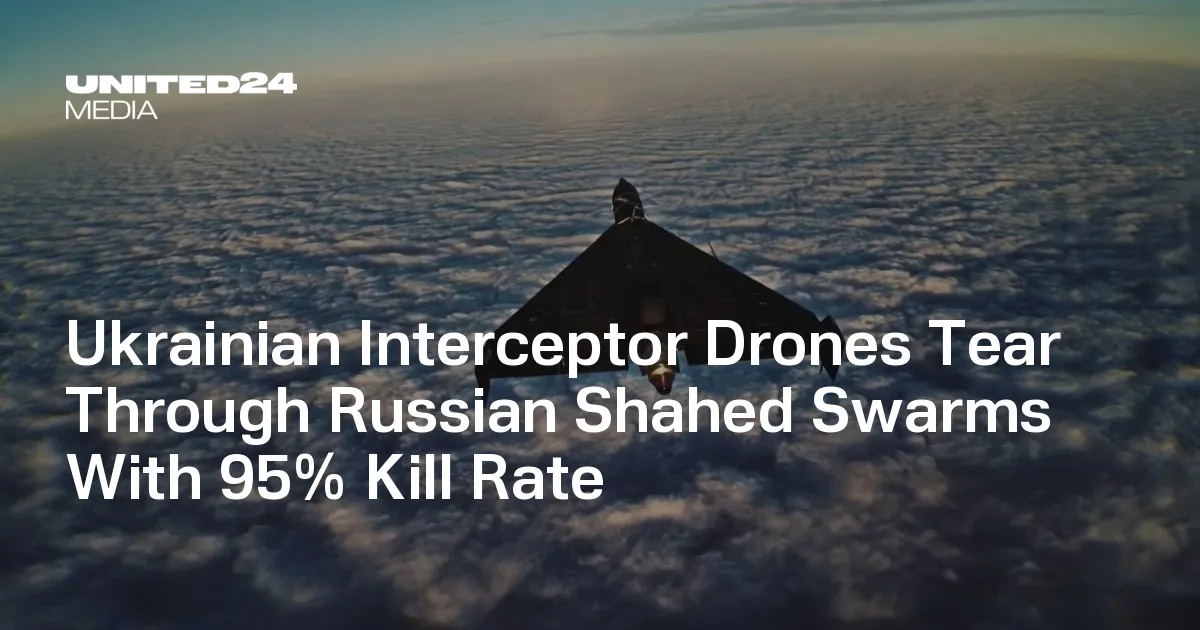
Ukraine has been developing a system of private air defense units to supplement its military capabilities. This evolution is crucial, especially as Russian forces increasingly deploy Shahed drones—unmanned aerial vehicles designed for precision strikes. These drones have emerged as a significant threat, capable of targeting mobile fire groups within Ukraine.
On April 17, 2026, a noteworthy development occurred in the Kharkiv region: Ukrainian interceptor drones achieved a remarkable 95% success rate against Shahed drones. This statistic is not just a number; it reflects the growing sophistication of Ukraine’s defensive measures. A Ukrainian pilot known as ‘Hulk’ recently downed two Shahed drones from an impressive distance of 500 kilometers. Such feats underscore the skill and determination of Ukrainian forces facing these aerial threats.
But what makes these Shahed drones particularly concerning? They typically operate at altitudes of 4 to 5 kilometers and are equipped with Tele2 SIM cards, which allow for communication but have their roaming blocked in Ukraine. This technical detail hints at the strategic planning behind their deployment, revealing that these drones are not just random tools of war—they are part of a calculated strategy by Russian forces.
Recently, an unprecedented event took place: a private air defense unit successfully shot down a high-speed ‘jet-powered’ Shahed drone traveling at speeds exceeding 400 km/h. This incident marks a new level of complexity in aerial warfare for both sides. Mykhailo Fedorov remarked, “This is a new level of complexity,” highlighting the ongoing arms race in drone technology between Ukraine and Russia.
As these developments unfold, observers note that Ukrainian air defense crews have destroyed around 200 targets, including 184 Shahed drones thus far. In just one day, they eliminated 20 of these threats—a testament to their efficiency and adaptability under pressure. The ability to launch an interceptor drone in just 30 seconds showcases the rapid response capabilities that have been honed through experience.
Yet, this technological battle has ethical implications as well. Serhii ‘Flash’ Beskrestnov stated, “I believe that mobile and fixed-line operators across the civilized world should terminate business relations with an operator used by the Russian Federation for terrorist purposes.” This call to action reflects the broader conversation surrounding corporate responsibility in wartime situations.
The stakes are high; each interception not only saves lives but also represents a strategic victory for Ukraine. As pilot ‘Hulk’ put it succinctly: “Do I feel like a superhero? Yes, because I understand that the lives of many civilians depend on me and my brothers.” His words encapsulate the gravity of their mission amidst ongoing conflict.
What happens next remains to be seen. Will advancements in drone technology shift the balance further? Details remain unconfirmed as both sides continue to adapt and evolve their strategies in this complex theater of war.
