Introduction
The peacock spider, belonging to the genus Maratus, has gained significant attention for its dazzling colours and intricate mating dances. Found primarily in Australia, these tiny arachnids epitomise the vibrant beauty of the natural world. Their uniqueness not only highlights the diversity of spider species but also plays a crucial role in the study of animal behaviour and evolution.
Physical Characteristics and Habitat
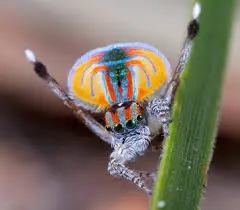
Peacock spiders measure approximately 5 millimetres in length and are renowned for their iridescent colours. The males, in particular, possess brightly coloured flaps that they display to attract females. With hues of blue, red, orange, and green, these spiders turn their courtship rituals into a visual spectacle. Their natural habitats range from dry woodlands to shrublands, primarily in eastern and southern Australia, where they thrive on the ground and among low vegetation.
Unique Courtship Rituals
The courtship display of the male peacock spider is remarkable. During mating season, males perform a series of structured dances, vibrating and raising their colourful flaps to entice potential mates. This intricate behaviour not only serves the purpose of attracting females but also involves complex movements that have been likened to a dance performance. The courtship behaviour varies between species; some make use of specific movements and colour displays to communicate their fitness and dominance.
Recent Studies and Conservation
Recent research highlights the evolutionary significance of these dancing displays, suggesting that sexual selection plays a vital role in the divergence of species within the Maratus genus. Scientists are increasingly examining how such behaviours can inform our understanding of evolutionary processes. Although the peacock spider does not face immediate threats, habitat loss and environmental changes could pose future challenges. Maintaining their habitats is key to ensuring their survival.
Conclusion
The fascination with peacock spiders showcases the intricate beauty and complexity of nature. As research continues to reveal more about these extraordinary creatures, awareness for their conservation becomes essential. Understanding their unique behaviours not only enriches our appreciation for biodiversity but also underscores the delicate balance of ecosystems. Observing peacock spiders in their natural setting offers a glimpse into the wonders of life and the importance of preserving such vibrant species.
