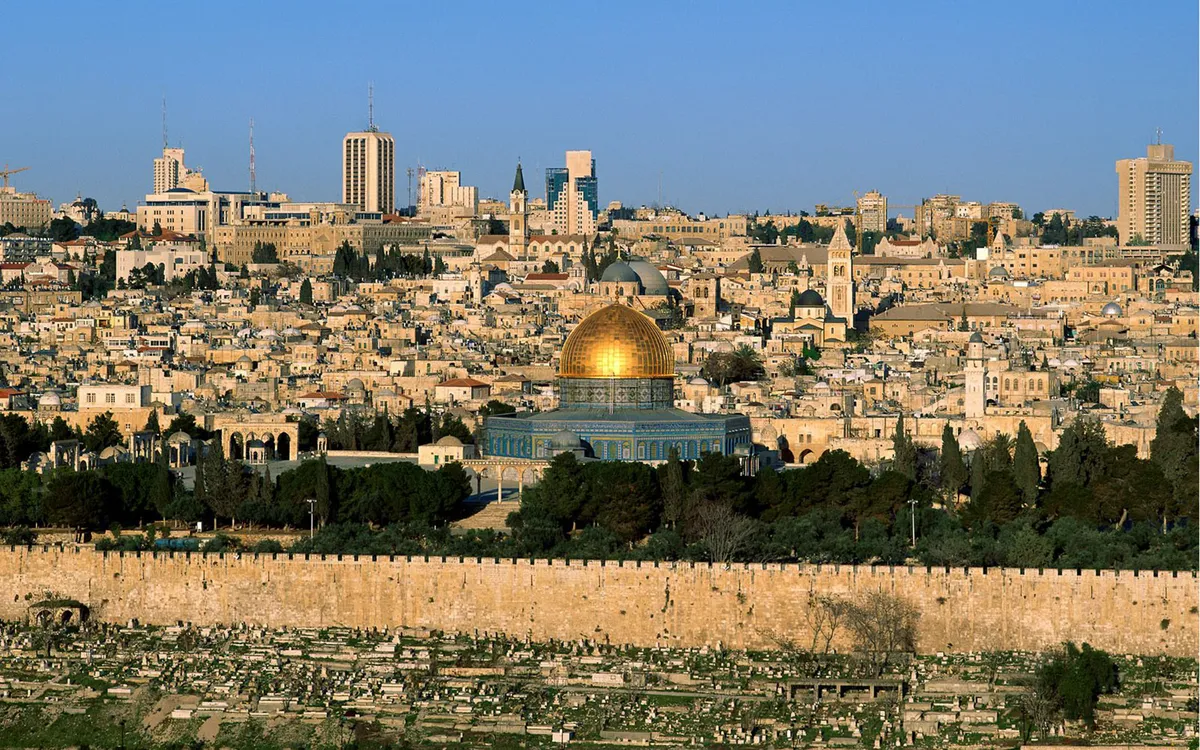
Israeli security forces clashed with Palestinian Christians attempting to access the Church of the Holy Sepulchre on Holy Saturday, marking a significant escalation in tensions surrounding Jerusalem’s religious sites. This incident follows a series of provocative actions, including Israeli National Security Minister Itamar Ben-Gvir’s storming of the Al-Aqsa Mosque compound on Orthodox Easter.
In a troubling development, the Al-Aqsa Mosque and the Church of the Holy Sepulchre were closed for 40 days during the recent US-Israeli war on Iran, a move that has drawn widespread condemnation. The Status Quo agreement, which has governed religious life in Jerusalem since the 16th century, is increasingly under threat as Israeli policies restrict Palestinian urban growth while expanding Israeli settlements.
Historically, the Status Quo was recognized in the Treaty of Paris (1856) and the Berlin Treaty (1878), serving as a crucial framework for maintaining peace among the various religious communities in Jerusalem. However, recent actions by Israeli authorities, including the forced self-demolition of homes in Jabal al-Mukabber, have led to increased displacement among Palestinian families.
Israeli authorities routinely pressure Palestinians to demolish their homes under the pretext of lacking building permits, with families facing the threat of bulldozers and steep charges if they refuse. This practice has contributed to a growing humanitarian crisis in the region.
In a related incident, Sheikh Mohammad al-Abassi, the imam of Al-Aqsa Mosque, was detained by Israeli forces, preventing him from entering the compound for a week. Observers note that “prayer has become an act of resistance” for many Palestinians in the face of ongoing oppression.
As tensions rise, the international community is urged to recognize that the Status Quo remains a vital safeguard against complete Israeli control over all aspects of life in Jerusalem. The situation is further complicated by Israel’s admission to the UN, which was conditioned upon its commitment to respect UN General Assembly Resolution 181.
Amidst these developments, IDF Chief of Staff Lt.-Gen. Eyal Zamir emphasized the importance of remembering the acts of bravery and resistance throughout history, particularly in light of the six million Jews murdered during the Holocaust. The 27th of the Hebrew month of Nissan, which marks Holocaust Remembrance Day, serves as a poignant reminder of the struggles faced by various communities.
As the situation continues to evolve, details remain unconfirmed regarding the long-term implications for Jerusalem’s religious sites and the broader geopolitical landscape. The international community watches closely, hoping for a resolution that respects the rights and identities of all communities involved.
