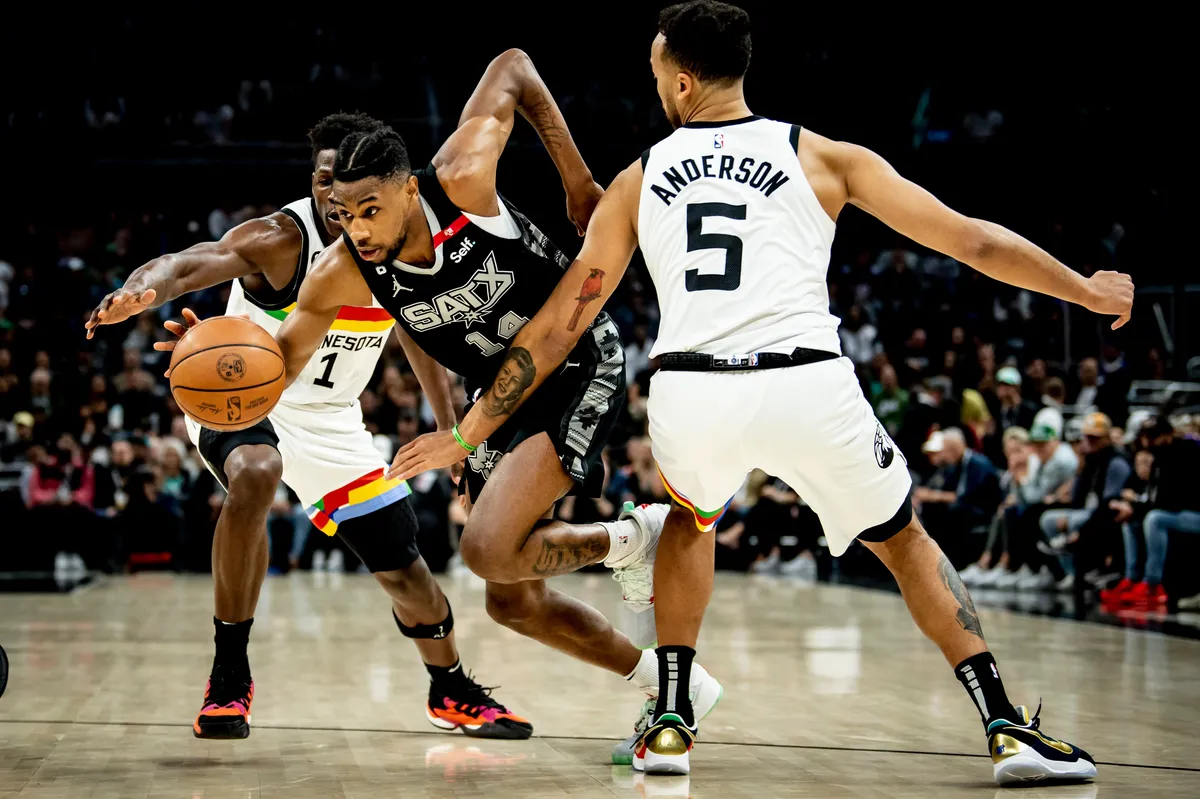
“It was obvious — literally from the jump, when skyscrapers Rudy Gobert and Victor Wembanyama squared off at midcourt — that every bucket of the Western Conference semifinals series between the Minnesota Timberwolves and San Antonio Spurs would be hard-earned,” said Jon Krawczynski after the game.
The Timberwolves pulled off a surprising upset in Game 1, winning 104-102 against the Spurs on May 5, 2026, at Frost Bank Center in San Antonio. This victory came despite Anthony Edwards’ recent injury, which had raised doubts about his effectiveness. Edwards scored 18 points off the bench, demonstrating resilience in his first game since April 25.
Julius Randle led the Timberwolves with 21 points and 10 rebounds, contributing significantly to their success. The game featured a nail-biting back-and-forth, with 19 lead changes and a largest lead of just 9 points. This reflects how closely contested playoff games can be.
The context matters because both teams entered this matchup with strong playoff performances. The Timberwolves had recently defeated the Denver Nuggets, while the Spurs eliminated the Portland Trailblazers in their first-round series. Yet, as Jared Weiss noted, “This was the moment the experience factor came into play, as the Spurs looked like they could not find their half-court identity.” This struggle allowed the Timberwolves’ defense to shine.
Victor Wembanyama’s performance also stood out—he recorded an astounding 12 blocks, marking one of the most impressive defensive displays in playoff history since 1973-74. However, for the Spurs to bounce back, Weiss emphasized that “the Spurs will need to find a way to generate better corner looks and get Wembanyama the ball on the roll.” This adjustment will be crucial for their offensive strategy moving forward.
The Timberwolves had six players finish with double figures in scoring, showcasing their depth and teamwork. As they look ahead to Game 2, they will aim to maintain this momentum while addressing any weaknesses exposed by the Spurs.
