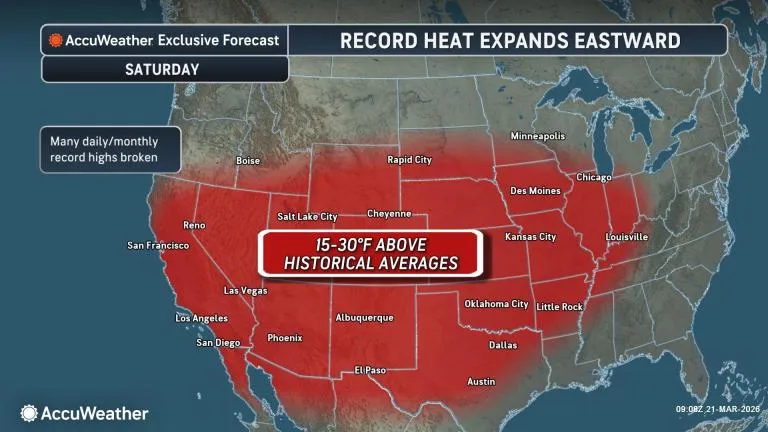
Temperatures across the western United States are soaring 15 to 30 degrees above normal, as a significant heat wave sets new records for March. Palm Springs, California, has reached an all-time March high of 108 degrees Fahrenheit, while Las Vegas recorded a high of 97 degrees Fahrenheit, marking its own all-time March record.
In Phoenix, the mercury climbed to 105 degrees Fahrenheit, and San Francisco shattered its previous March record by 4 degrees, peaking at 89 degrees Fahrenheit. This extreme weather is attributed to a massive area of high pressure creating a ‘heat dome’ over the region.
The Southwest is experiencing unprecedented heat for March, with temperatures in Arizona hitting as high as 110 degrees Fahrenheit. Hiking trails have been closed due to the extreme heat and the associated risk of dehydration, highlighting the immediate impacts of this weather phenomenon.
According to recent statistics, the area of the U.S. affected by extreme weather has doubled in the past five years compared to two decades ago. Furthermore, the United States is breaking 77% more hot weather records now than it did in the 1970s, indicating a concerning trend in climate patterns.
As Andrew Weaver noted, “What used to be unprecedented events are now recurring features of a warming world.” This sentiment is echoed by climate experts who assert that events as warm as those currently being experienced would have been virtually impossible without human-induced climate change.
Bernadette Woods Placky remarked, “It’s really hard to even keep up with how extreme our extremes are becoming,” emphasizing the rapid pace at which these weather patterns are evolving. Friederike Otto added, “This is due to climate change, that we see more extreme events, and more intense ones and have so many records being broken.”
Daily records are expected to continue being broken throughout the weekend, as the heat wave persists. The rapid thaw associated with these high temperatures could also lead to a premature depletion of snowpack, potentially affecting water supply in late spring and summer.
As the situation develops, observers are closely monitoring the ongoing heat wave and its implications for both the environment and public health. Details remain unconfirmed regarding the full extent of the impact this heat wave will have on local ecosystems and water resources.
