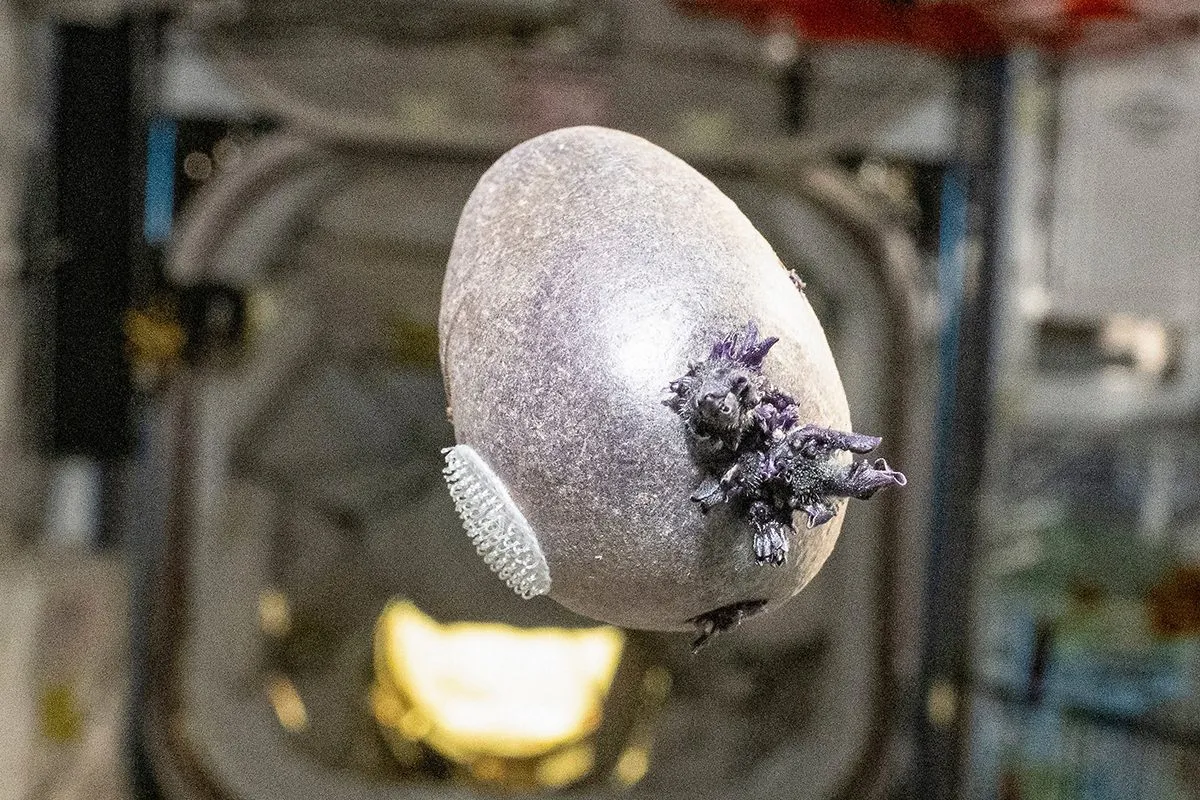
On March 20, 2026, astronaut Don Pettit posted a photo of a purple potato, affectionately named Spudnik-1, grown aboard the International Space Station (ISS). This unique potato was cultivated during Expedition 72, which spanned from September 2024 to April 2025, marking a significant step in NASA’s ongoing experiments with space agriculture.
The potato, notable for its high levels of anthocyanins, a natural pigment, was part of Pettit’s off-duty activities in his space garden. He utilized Velcro to anchor the potato in an improvised grow-light terrarium, allowing it to thrive in the microgravity environment of the ISS. Pettit remarked, “I flew potatoes on Expedition 72 for my space garden, an activity I did in my off-duty time.”
During his four space missions, totaling 590 days in orbit, Pettit has become an advocate for growing food in space. He cited the book and movie “The Martian” as inspiration for his potato-growing efforts, emphasizing the importance of food production systems for long-duration missions to Mars and potential permanent bases on the Moon.
Potatoes are considered one of the most efficient plants in terms of edible nutrition relative to total plant mass, making them an ideal candidate for space farming. Pettit noted, “Potatoes are one of the most efficient plants based on edible nutrition to total plant mass, including roots.” This efficiency is crucial as NASA explores sustainable food sources for future missions.
The photo of Spudnik-1 quickly went viral, sparking theories about alien life on social media. The tentacle-like appearance of the potato, attributed to its roots growing in microgravity, added to the intrigue. Pettit humorously described the potato, stating, “This is an early purple potato, complete with a spot of hook Velcro to anchor it in my improvised grow-light terrarium.”
NASA’s research into growing food in space is not just a novelty; it is a vital component of planning for extended missions beyond Earth. As space agencies focus on establishing permanent bases on the Moon and preparing for human exploration of Mars, initiatives like Pettit’s potato garden could play a pivotal role in ensuring astronauts have access to fresh food.
As the conversation around space agriculture continues, Pettit’s efforts serve as a reminder of the innovative approaches being explored to sustain human life in outer space. The successful growth of Spudnik-1 could pave the way for more extensive agricultural projects in the future, contributing to the feasibility of long-term human presence on other celestial bodies.
