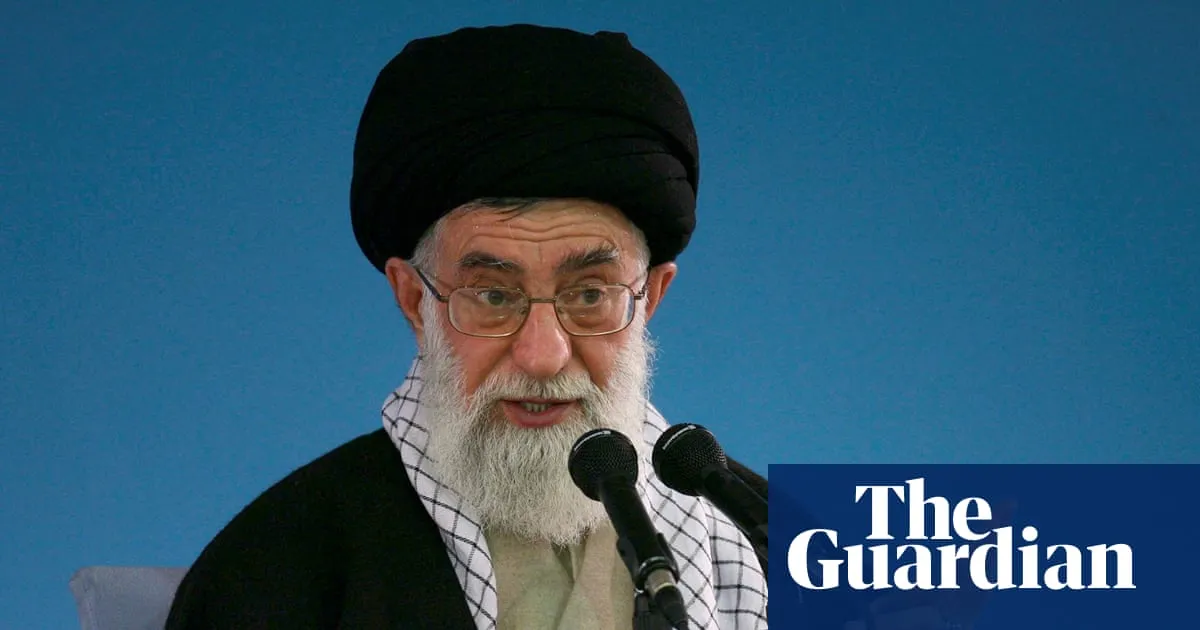
Iran’s Supreme Leader Ayatollah Ali Khamenei Killed in US-Israeli Airstrike
Iran’s supreme leader, Ayatollah Ali Khamenei, has been confirmed dead following a coordinated airstrike by the United States and Israel. He was 86 years old.
Iranian state media reported the news early Sunday, shortly after US President Donald Trump announced that Khamenei had been killed in a joint operation targeting his compound on Saturday. The semi-official Tasnim News Agency stated, “It is announced to the Iranian people that His Eminence Grand Ayatollah Imam Sayyid Ali Khamenei, Leader of the Islamic Revolution, was martyred in the joint attack launched by America and the Zionist regime on the morning of Saturday, February 28.” Reports also indicated that Khamenei’s family members, including his daughter, son-in-law, and grandson, were killed in the attack.
Trump claimed that Khamenei and other Iranian officials were unable to evade US intelligence and advanced tracking systems.
Khamenei’s Rise to Power
Khamenei ascended to the position of supreme leader in 1989, following the death of Ayatollah Ruhollah Khomeini, the influential figure behind the Islamic Revolution a decade earlier. While Khomeini was the ideological leader of the revolution that dismantled the Pahlavi monarchy, Khamenei was instrumental in developing the military and paramilitary structures that fortified Iran’s defense and extended its influence beyond its borders.
Prior to his leadership, Khamenei served as president during the Iran-Iraq War in the 1980s. This protracted conflict, coupled with a sense of isolation as Western nations supported Iraqi leader Saddam Hussein, fostered Khamenei’s deep-seated distrust of the West, particularly the United States, according to analysts.
Vali Nasr, an expert on Iranian affairs, noted, “People think [of Iran] as a theocracy, because he [Khamenei] wears the turban and the language of the state is the language of religion, but in reality, he was a wartime president that came out of war with the assumption that Iran is vulnerable and in need of security.” This perspective led to the evolution of the Islamic Revolutionary Guard Corps (IRGC) from a paramilitary force into a dominant security and political institution.
Challenges During Khamenei’s Rule
Khamenei’s leadership faced significant challenges, including the 2009 protests against a disputed presidential election and the 2022 demonstrations regarding women’s rights. The most formidable challenge arose in January 2026, when protests sparked by economic hardship escalated into widespread calls for the overthrow of the Islamic Republic, resulting in violent confrontations.
Critics argued that Khamenei was increasingly disconnected from a younger population that sought reforms and economic improvement rather than continued isolationism and conflict with the US and Israel. Nasr remarked, “Iranians paid too high a cost for this degree of insistence on national independence – in the process, he lost the Iranian population because they no longer believed in the wisdom of this independence.”
Khamenei’s Early Life and Education
Born in 1939 in Mashhad, Iran, Khamenei was the son of a prominent Muslim leader. He began his education at the age of four, studying the Quran and later attending theological schools in Najaf and Qom, where he became acquainted with Khomeini.
As a political activist, Khamenei faced multiple arrests and was exiled by the shah’s secret police. He returned to Iran to participate in the 1978 protests that ultimately led to the fall of the Pahlavi regime.
Establishing Authority as Supreme Leader
Following the revolution, Khamenei played a crucial role in shaping the new Iranian state, briefly serving as minister of defense and later as the supervisor of the IRGC during the Iran-Iraq War. His presidency began in 1981, and he survived an assassination attempt that year, which resulted in the loss of the use of his right arm.
In 1989, Khamenei was appointed as supreme leader after Khomeini’s death, despite initial controversy regarding his qualifications. His leadership was marked by efforts to rebuild a war-torn nation and to establish a robust military apparatus.
Domestic and Foreign Policy
Khamenei’s early tenure focused on reconstructing the country after the Iran-Iraq War, which had resulted in significant casualties and economic devastation. His leadership style was characterized by a commitment to resistance against perceived external threats, particularly from the West.
In the 1990s, as the revolutionary fervor waned, Khamenei faced challenges from reformist movements. He perceived these movements as threats to the status quo and sought to consolidate a loyal voting bloc to counter reformist influence.
His approach included empowering the IRGC, which expanded its role in both the economy and politics, while also intensifying training programs for younger members of the paramilitary forces.
Negotiations and Tensions with the West
In 2015, Khamenei approved negotiations with Western powers that led to the Joint Comprehensive Plan of Action (JCPOA), aimed at curbing Iran’s nuclear program in exchange for sanctions relief. However, following the US withdrawal from the agreement in 2018, Khamenei reverted to a more aggressive stance, ruling out further negotiations with the US.
As protests erupted in Iran in 2019 and again in 2022, Khamenei’s government faced increasing scrutiny and unrest. The protests were often met with violent crackdowns, leading to significant casualties.
The Aftermath of Khamenei’s Death
With Khamenei’s death, Iran faces a critical juncture. The leadership vacuum raises questions about the future direction of the Islamic Republic and its relations with both domestic and international actors. The response from the Iranian populace and the international community will shape the next chapter in Iran’s complex political landscape.
As the nation grapples with the implications of this significant loss, the legacy of Khamenei’s rule will undoubtedly influence the trajectory of Iran’s future.
